
Batting for Change: Repair and Reuse Take Root in Local Cricket
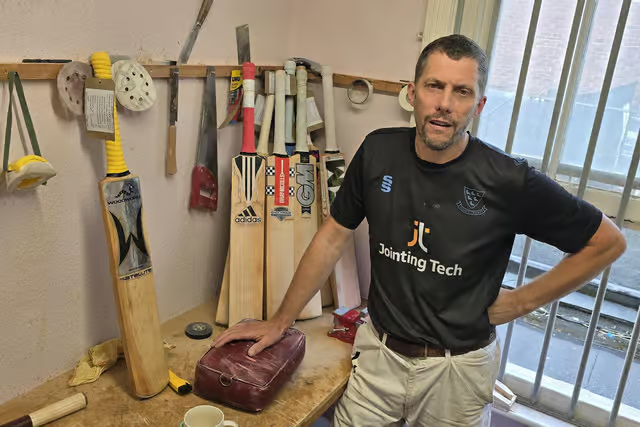 In a small workshop in Haywards Heath, cricket bats are being restored to life. Barney Morris, better known as Barney Bats, repairs around 50 damaged bats each week. After a busy weekend of matches, his workbench can resemble a triage unit as bats arrive in need of care and attention.
Morris, who runs the cricket department at Wisdom Sports in town, is on a mission to prove that a cracked bat need not be discarded. His passion began when he started fixing senior bats for junior players, driven by the high cost of new kit. “The price of cricket bat willow means getting a good bat is really expensive,” he explained. “Now I get donated adult bats which I can repair and resize for children and I can sell them at a fraction of the cost of a new bat.”
This local reuse initiative reflects a growing shift towards circularity in sport. The Farnham-based Centre for Sustainable Design (CfSD) recently coordinated Cricket Gear Reuse (CGR) pilot schemes in the Farnham area of Surrey and in Wandsworth, South London. In summer 2024, clubs collected and redistributed over 500 items including bats, pads, gloves and shirts that might otherwise have ended up unused or in landfill. These schemes saved approximately 1.5 tonnes of CO₂ emissions and diverted over 100 kilograms of gear from the waste stream. The items of kit were collected, checked and sorted through drop-off points at local cricket clubs and at a convenience store and then redistributed to state schools, young players and an Afghan refugee.
Building on this success, in 2025 CfSD has helped establish the Circular Cricket Gear Hub at Spencer Cricket Club in Wandsworth (the largest recreational cricket club in the UK), in partnership with Surrey Cricket Foundation and Decathlon UK. This is an integrated part of the club’s Spencer ONE community outreach and engagement initiative. An online tool is also being developed by CfSD to register donations, match items to need and monitor the wider social and environmental benefits.
Professor Martin Charter, Director of CfSD, believes reuse projects like these deliver real value. “Donating discarded gear gives a great entry point into the sport for young people, especially those for whom it is unaffordable,” he says. “It reduces waste and emissions, cuts costs for families and brings unused kit back into play.
Cricket continues to face challenges around inclusion. Research led by Birmingham City University and Warwickshire CCC found that white players educated in private schools are far more likely to reach professional levels than their state-educated peers, while British South Asian cricketers were 34 times less likely to get to pro level, whatever their educational background. The costs of equipment, coaching and access are a significant part of the problem.
Repair and reuse projects offer a practical response. Whether it is Barney Morris’s growing bat repair service in Haywards Heath, or club-led donation schemes supported by the Cricket Gear Reuse (CGR) toolkit, these efforts make the game more affordable and accessible. Clubs and schools across Sussex are encouraged to get involved. The CGR Toolkit, available free online, offers templates, posters and step-by-step guidance for starting a local reuse scheme: www.cfsd.org.uk/projects/cgr/tools
At Sussex Green Living, we believe sustainability and fairness go hand in hand. Whether it is donating a pair of spare pads, repairing a bat or starting a club kit exchange, every action helps create a more inclusive, circular future for the game and for our communities.
Barney Bats: https://www.facebook.com/profile.php?id=61566447666182

 Community Wellbeing Garden
 Sussex Green Living
 Sussex Green Living
 Biffa
Biffa