
 Biffa
BiffaHow our food waste creates green energy
By now, those of us living in the Horsham area are becoming familiar with putting out our food waste every week together with either the general waste bin or the recycling bins. After three months, the take up is already around 60% which is notably above the national average. It is very much hoped, as the habit settles in, this percentage can be significantly increased.
As the Sussex Green Living representative on the local liaison committee for the Biffa run Brookhurst Wood Anaerobic Digestion Resource Recovery Facility (ADRRF), I was particularly pleased to be given a tour of the recently installed plant – and it is impressive.
Whilst we may look into our caddy and think that the waste doesn’t amount to very much- it does, as it all makes a valuable contribution to what is collected overall. Biffa are expecting in these early years to process around 30,000 tonnes of food waste per annum. They have the capacity to ramp that up if needed so it really is an ‘every little helps’ cumulative gain.
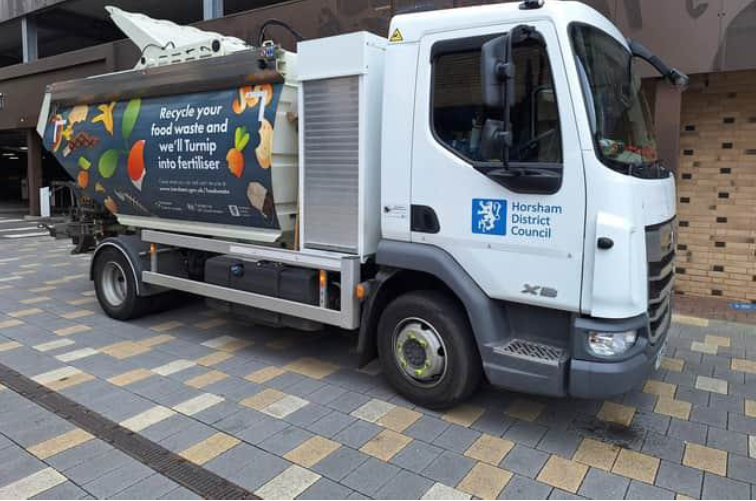
Your food bin is emptied into a specially designed transport vehicle before being transferred to a larger container. Horsham District Council ran a competition to name a couple of these trucks which are to be called the Green Monster Muncher (thought up by Colgate Primary School) and Food-y the Dude-y (Kingslea Primary School).
On arrival at the Biffa site any obvious contaminants are first removed, water added, put through a Hammer Mill and then an Eviscerator to remove smaller foreign bodies, and heated to 70% to kill off harmful bugs and bacteria.
The porridge like substance is then pumped into an oxygen free anaerobic digestor that contains beneficial living bacteria which, over a period of two to three weeks, turns around 95% of the food waste into Biogas. This energy is used to help power the plant, including the equipment used in repurposing the food waste, with unused energy going back into the National Grid. The 5% residue is not wasted either as it is utilised as a fertiliser to increase nutrient levels on agricultural land.
Our efforts really are creating a ‘win – win’ situation; and there is a further benefit in that the amount now going to landfill has been proportionately reduced. Not the landfill site at the Brookhurst Wood site as that closed last year and is being rewilded – which is already attracting some fascinating species such as the rare Grizzled Skipper Butterfly. Keep an eye out for an ever greener hill on the site.
One consequence to be mindful of now that food has been separated out from other rubbish is that your general waste is drier. This can increase the fire risk during the waste collection process so it is more important than ever to make absolutely certain no batteries of any kind are put in your waste bins.
You can find out lots about recycling and repurposing initiatives by visiting Sussex Green Living’s Hub at the United Reformed Church in central Horsham on the last Saturday of every month between 10am and 2.30pm.
By Paul Bellringer OBE

 Community Wellbeing Garden
 Sussex Green Living
 Sussex Green Living
 Biffa
Biffa
 Sussex Green Living
 Sussex Green Living