
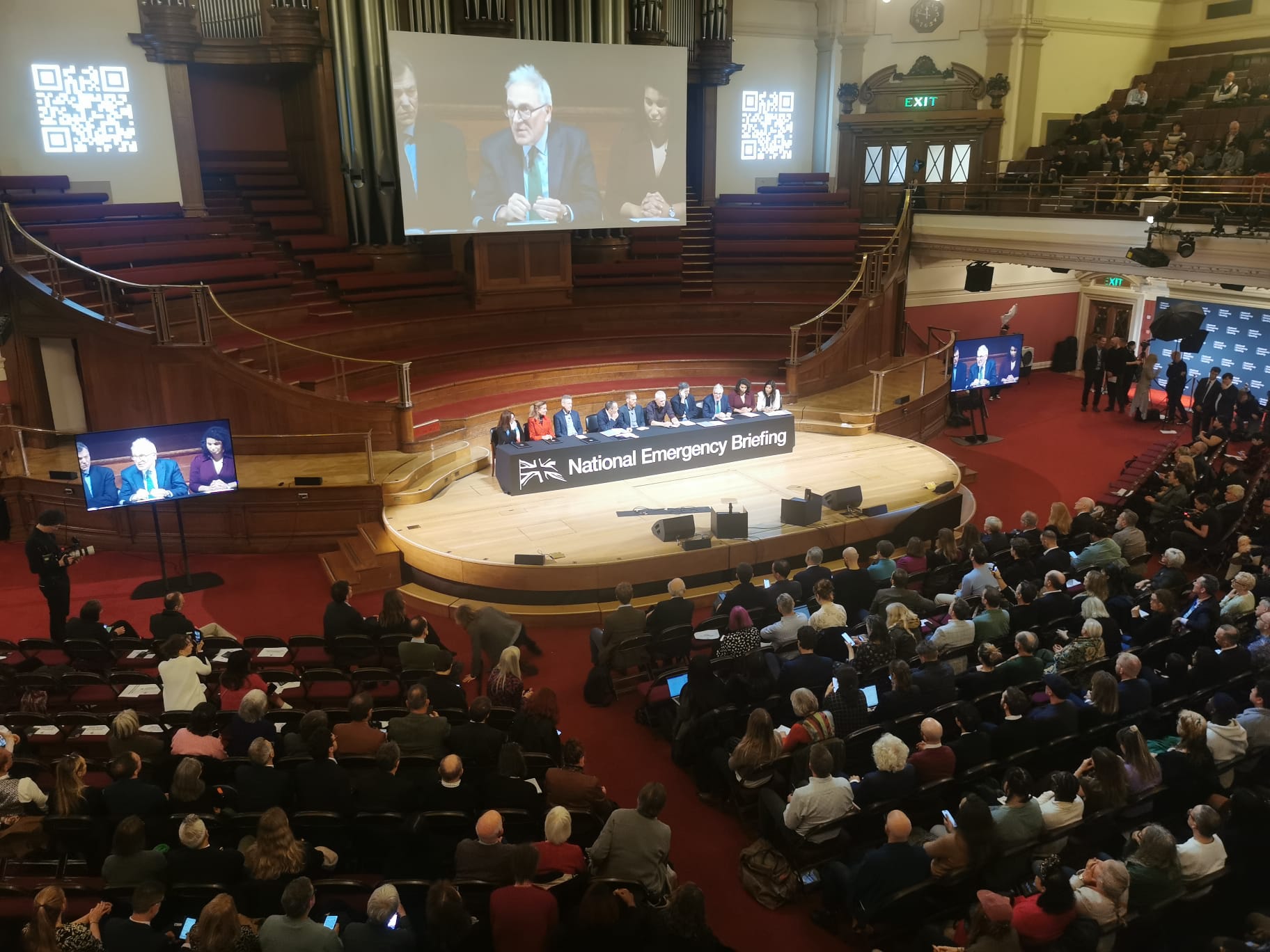
 On 27 November 2025, Central Hall Westminster, London, was buzzing with an invite-only audience of around 1,250 politicians, scientists and leaders from business, culture, faith, sport and the media. Also in attendance were familiar faces like Chris Packham, Deborah Meaden, Jennifer Saunders, Mark Rylance, Brian Eno, Roger Harrabin and four of the Sussex Green Living team.
They learnt about the latest implications for health, food, national security and the economy. They weren’t there for show. They came because the National Emergency Briefing, convened by brothers Simon and Nick Oldridge, brought together some of the UK’s most respected scientific voices to share the latest evidence on nature and climate risks — with the solutions already proving effective.
The campaign behind the briefing includes both experts and everyday citizens, supported by organisations such as The National Trust, Wildlife & Countryside Link, Wetlands for Life, the RSPB, and the Royal Meteorological Society. Their shared aim is to help decision-makers understand the scale of the challenge, using data from the Met Office, the IPCC, the UK Climate Change Committee and leading economic and nature-impact assessments.
The evidence presented remains clear:
– UK temperatures are rising and extreme weather events — from flooding to heatwaves — are becoming more frequent and intense.
– Global wildlife populations have declined by 79% since 1970, with 1 in 6 UK species now at risk of extinction.
– Food prices and energy costs are increasingly affected by global climate instability and domestic vulnerabilities, such as inefficient housing and reliance on imported fuel supplies.
These aren’t predictions; they’re trends already measured and documented across the country, yet the tone of the day stayed focused on solutions, not despair. Speakers highlighted what’s proven and working now: renewable energy, which has cut electricity costs by up to 70% over the past decade; flood-absorbing- climate-mitigating green spaces that protect homes; regenerative farming methods that improve soil health and reduce fertiliser costs; plus home upgrades that cut bills while keeping people healthier and happier.
There was an emphasis on transparency. People want clear information, not exaggerated promises or political point-scoring. The celebrities who attended reflected the wider mood: a desire for honesty, practicality and a sense that everyone has a role — not just experts or activists. As Brian Eno said, “Movements grow when people realise they’re not alone, when they can see themselves in the solution.”
The spirit in the hall was one of grounded optimism: acknowledging the size of the challenge without assuming it’s beyond us. Progress, the speakers reminded everyone, comes from steady, collective steps — not overnight miracles.
That leads naturally to the question of what can any of us do? Please sign this letter www.nebriefing.org appealing to our PM, BBC, ITV, Channel 4, Channel 5, S4C and Ofcom to deliver urgently and truthfully, with ambition matching the scale of the crisis.
The opening speeches and nine presentations given at the National Emergency Briefing can be seen on You Tube here:
Introduction – Prof Mike Berners-Lee (Chair) | National Emergency Briefing
A 45 minute documentary entitled the Peoples Emergency Briefing is being produced and is being screened in Horsham as part of the Horsham Green Film Fest on 21st April, learn more here.
Alternatively subscribe on the www.nebriefing.org for opportunity to host a screening in your community.
Whether or not you choose to write, the most important thing to remember is every voice heard can contribute to the direction we take. If you believe in a secure, thriving future for the UK, adding your voice, in whatever way feels comfortable for you, can help move us closer to it.
By Elle Runton

 Sussex Green Living
 GS Creative Photography
 Bex Bastable
 Pexel
Pexel