Seal of success! by Keir Hartley (first published in West Sussex County Times)
/in Biodiversity & Nature, Climate change, Eco News, Ecology/by Marianne LindfieldSeals on our Sussex coast show that conservationists are getting something right. It’s not just Gavin the well-loved harbour seal who sports with paddle boarders in Littlehampton; we can see these marvellous creatures now in Chichester harbour, Eastbourne and in the Adur, where two seals named Bramble and Rivier (who swam in from Belgium) have generated their own following.
According to Zoologist Stephen Savage of the Sea Watch Foundation, it’s a wonderful sign that our waters are clean enough to support food for these large animals. “They like mullet, flatfish and crabs mainly” he explains, “but they hunt anywhere in tidal or brackish water, even as far up as The Black Rabbit at Arundel.”
Stephen, who is County Recorder for Sea Mammals, has studied seals since 1997. The public have been stalwart supporters. Initially he collated sighting reports, but eight years ago increasing seal numbers allowed him to build a picture of populations in Sussex. “We hope to learn even more through citizen science” says Stephen. “The interaction of seals and people will significantly add to this story.” Read more
Bright future enjoyed by St Mary’s School
/in Children & nature, Climate change, Eco News, Education, Events, Green art & games, Health and wellbeing/by Carrie CortThanks to our Tesco Community Grant we were able to take our Bright New Futures Roadshow to St Mary’s CofE Primary School in Pulborough on the 22nd July . This is a large school with a new teacher leading their Eco activities. We started the planning process with the school many months in advance, then […]
How Green is Copper? by Nicola Peel
/in Climate change, Eco News, Ecology/by Marianne LindfieldHow Green is Copper? With a rush for electric cars and renewable power some of the most biodiverse areas on Earth are under threat. Hidden beneath primary forest teeming with life metals lay buried.
Whilst Ecuador was the first country in the world to put the #rightsofnature in its #constitution, sadly this has not stopped foreign interest from wanting to mine one of the most biodiverse places on the planet.
The Los Cedros Reserve is almost 12,000 acres of untouched cloud forest. Imagine over 400 different kinds of orchids, over 350 species of birds, 800 different kinds of moths and uncountable species of fungi. 5 critically endangered and 31 endangered species make this their home.
This little known reserve is more biodiverse than the Amazon.
Still the Canadian mining company Cornerstone Capital Resources buy off the local people with trinkets , beads and the promise of work. They do not talk about the potential risk of contaminating their water source or of what will happen when they leave.
The world is watching this vital case. If Nature wins it means that not only Los Cedros can breathe a sigh of relief but over 6 million acres of protected land which is under the threat of mining. This will in turn set an international precedent. Read more
Tesco grant helps us share Bright New Future
/in Children & nature, Climate change, Education, Events, Health and wellbeing/by Carrie CortThanks to a Tesco Community grant on 8th July we took our Bright New Future Roadshow to Kingslea School in Horsham where we worked with 60 children from Year Two who had been studying Our Blue Planet. Our original plan was to attend their school summer fete, but owing to covid this was postponed, and […]
Destroying (the) Amazon – Think Local by Morag Warrack
/in Children & nature, Climate change, Eco News/by Marianne LindfieldWe have decided to remove sponsorship from Amazon from our website with the realisation that it contributes to so many of the problems we are all striving to resolve.
The brilliant choice of the word “Amazon” is a stroke of genius- linked with one of the most life-sustaining, essential things on the planet!
Calling a Dumfries warehouse a ‘fulfillment centre’ smacks of Orwell’s gripping novel, 1984. Maybe it should properly be called a ‘full-Fill-ment centre’ as brand new products such as laptops and TVs are simply sent away to be buried in the ground from it, as landfill is cheaper than re-distributing them around the UK or donating them to schools and hospitals.
As the richest man in the known universe, Amazon owner Jeff Bezos made UK sales worth £14,000,000,000 in one year (2019) alone. He has a personal fortune of £155,000,000,000. However, he pays minimal UK tax by claiming small profits. It seems customers are unaware of the full story of buying and throwing away, over and over again, while gradually undermining small, local businesses in the long term. One charming designer I met cheerfully described his job, (working for several large chains based in China and Horsham) by saying, “I make landfill!” Read more
Wow No Cow! by Keir Hartley (first published in West Sussex County Times)
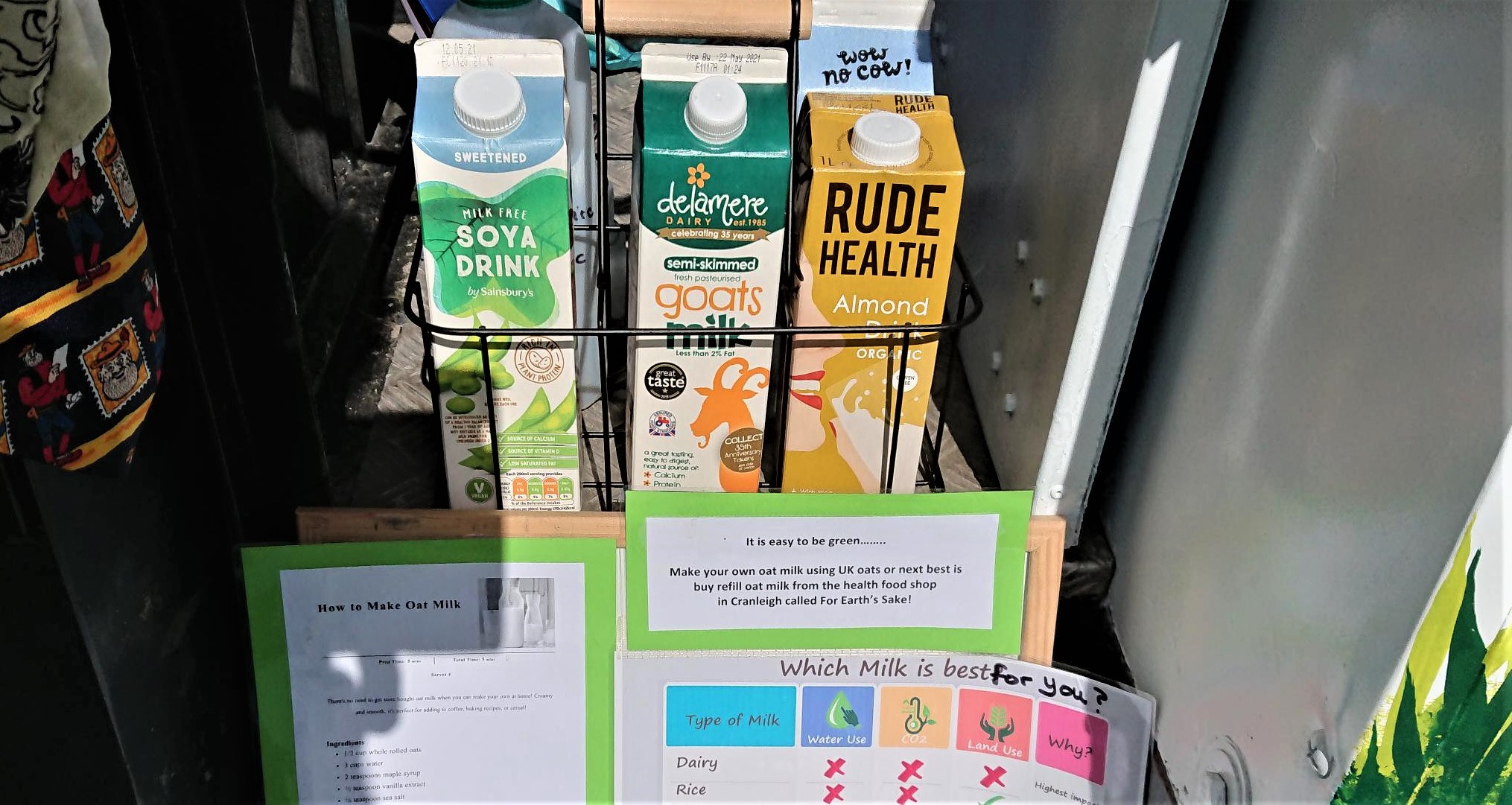
/in Climate change, Eco News, Ecology, Food Waste, Health and wellbeing/by Marianne LindfieldIf you are reading this column, there’s a good chance that you have an urge to do ‘the right thing’. You’re the sort who’s first to help in a crisis. You were the first to raise the subject of climate change. And the first to actually do something about it! And what better first step than to start making educated choices in the way you shop? No more plastic bottles and dodgy packaging. You started shopping locally, avoiding waste, noticing how sustainable food might or might not be. And you are right.
But it’s complicated, isn’t it?.
Take milk as an example. To produce it from a cow is incredibly destructive. A study by Oxford University tells us that producing a glass of dairy milk results in almost three times the greenhouse gas emissions of any non-dairy milks! It takes approximately 120 litres of water, 150 square centimetres of land and produces 0.6 kg of carbon emissions to produce one 200ml glassful.
For almond milk, however, the figures are 78 litres of water, a mere 10 square centimetres of land and 2kg of CO2 emissions. It sounds like a no brainer, until you drill down – which is exactly what they have had to do in California! The Golden State is responsible for 80% of the world’s almond production which requires enormous plantations which slowly deplete and dry the soil. Farmers drill ever deeper to quench their thirsty crops, bringing up saltier water. This speeds up desertification, which in turn leads to fires, and the strong possibility of no more almond trees. Read more
To Fly or Not to Fly by Anne Davies (first published in West Sussex County Times)
/in Climate change, Eco News, Ecology, Transport/by Marianne LindfieldBeyond Be-Leaf: A Day in the Woods by Liz Stack
/in Biodiversity & Nature, Children & nature, Climate change, Eco News, Ecology, Education, Health and wellbeing, Youth Eco Forum/by Marianne LindfieldLatest Posts
Could you be Sussex Green Living’s London Marathon runner?26 August 2026 - 18:23
Sussex Green LivingHow to Develop Healthier Soil That Pollinators Can’t Resist12 August 2026 - 11:04
People’s Emergency Briefing film9 July 2026 - 17:21
Ready to make a world of difference? 9 July 2026 - 17:12
e-Newsletter Sign-up
Get every post & our e-news to your inbox.
Search