Thanks to our Tesco Community Grant we were able to take our Bright New Futures Roadshow to St Mary’s CofE Primary School in Pulborough on the 22nd July . This is a large school with a new teacher leading their Eco activities. We started the planning process with the school many months in advance, then […]
00Carrie Corthttps://www.sussexgreenliving.org.uk/wp-content/uploads/2026/07/SGL-logo-masthead.pngCarrie Cort2021-09-06 15:02:442021-09-06 15:02:44Bright future enjoyed by St Mary’s School
What is in the Great Green Hamper? Bottle of Method – Wild Rhubarb anti-bac Bottle of Method – Peach Blossom anti-bac EcoVibe dish brush EcoVibe dish soap EcoVibe compostable sponge x 2 Circular & Co reusable 227ml cup Sea Saver microfilter bag Isle of White Gin 3 x mini Mermaid Gin Crumbs Brewing beer gift […]
00Marianne Lindfieldhttps://www.sussexgreenliving.org.uk/wp-content/uploads/2026/07/SGL-logo-masthead.pngMarianne Lindfield2021-09-02 10:16:552021-09-02 10:16:55John Lewis donates ‘Great Green Hamper’ for Christmas updates on ‘Small Green Steps survey’
Thanks to a Tesco Community grant on 8th July we took our Bright New Future Roadshow to Kingslea School in Horsham where we worked with 60 children from Year Two who had been studying Our Blue Planet. Our original plan was to attend their school summer fete, but owing to covid this was postponed, and […]
00Carrie Corthttps://www.sussexgreenliving.org.uk/wp-content/uploads/2026/07/SGL-logo-masthead.pngCarrie Cort2021-09-01 16:43:292021-09-01 16:43:29Tesco grant helps us share Bright New Future
If you are reading this column, there’s a good chance that you have an urge to do ‘the right thing’. You’re the sort who’s first to help in a crisis. You were the first to raise the subject of climate change. And the first to actually do something about it! And what better first step than to start making educated choices in the way you shop? No more plastic bottles and dodgy packaging. You started shopping locally, avoiding waste, noticing how sustainable food might or might not be. And you are right.
But it’s complicated, isn’t it?.
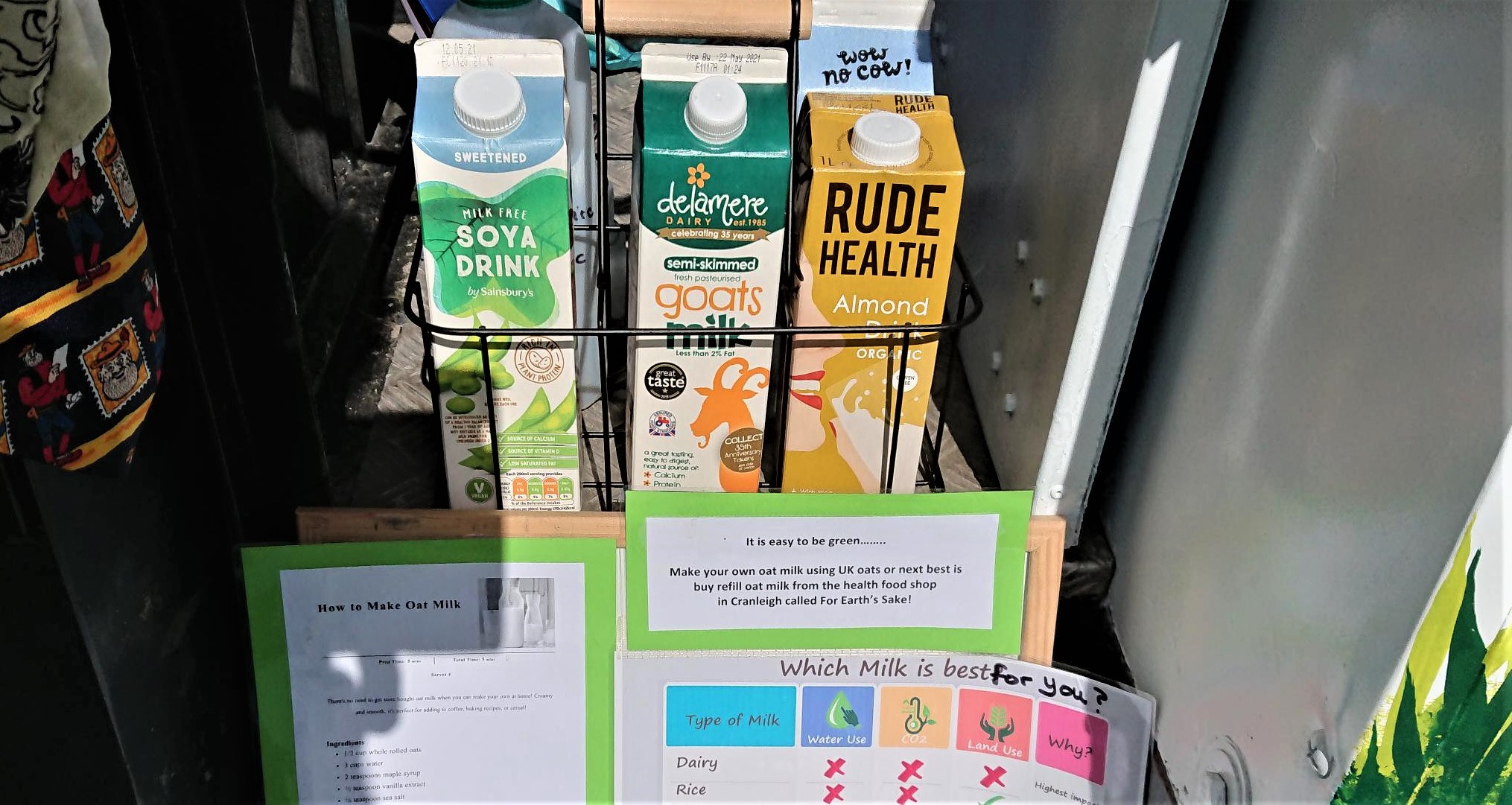
Take milk as an example. To produce it from a cow is incredibly destructive. A study by Oxford University tells us that producing a glass of dairy milk results in almost three times the greenhouse gas emissions of any non-dairy milks! It takes approximately 120 litres of water, 150 square centimetres of land and produces 0.6 kg of carbon emissions to produce one 200ml glassful.
For almond milk, however, the figures are 78 litres of water, a mere 10 square centimetres of land and 2kg of CO2 emissions. It sounds like a no brainer, until you drill down – which is exactly what they have had to do in California! The Golden State is responsible for 80% of the world’s almond production which requires enormous plantations which slowly deplete and dry the soil. Farmers drill ever deeper to quench their thirsty crops, bringing up saltier water. This speeds up desertification, which in turn leads to fires, and the strong possibility of no more almond trees. Read more
00Marianne Lindfieldhttps://www.sussexgreenliving.org.uk/wp-content/uploads/2026/07/SGL-logo-masthead.pngMarianne Lindfield2021-08-19 13:54:152021-08-19 13:54:15Wow No Cow! by Keir Hartley (first published in West Sussex County Times)
00Marianne Lindfieldhttps://www.sussexgreenliving.org.uk/wp-content/uploads/2026/07/SGL-logo-masthead.pngMarianne Lindfield2021-07-28 12:01:182021-07-28 12:01:18Beyond Be-Leaf: A Day in the Woods by Liz Stack
At our next Sussex Green Ideas online meeting, on July 21st at 7.00pm, we will be useing two books to help identify what Horsham District groups could usefully build now – and by 2030.
Chris Goodall – “What do we need to do now?” (discussed at Steyning Green Books 6/5/21 https://www.youtube.com/watch?v=UrxFSLl9tsw). Chris explained a number of uncomfortable truths relating to food and agriculture (one quarter of the world’s emissions), travel, domestic buildings and clothing (fast fashion)
He then identified what local groups could do, focusing also on working together and making lives better. We have chosen to focus on food, agriculture and clothing in our meeting*.
In the first part, we will look at his suggestions for:
Food and agriculture – He suggested The Kindling Trust as a model of community horticulture.
Clothing. He suggested The Clothing Warehouse Ltd as a model for recycling clothes (and household textiles). And initiatives that improve sewing skills (like our Horsham Repair Cafe) and use alternatives to cotton. We are going to be joined by Karrie Mellor one of our trustees and the founder of Bags of Support, a West Sussex textile recycling initiative run for social and environmental purpose. Read more
00Carrie Corthttps://www.sussexgreenliving.org.uk/wp-content/uploads/2026/07/SGL-logo-masthead.pngCarrie Cort2021-07-09 15:46:592021-07-09 15:46:59Lets visualise Horsham in 2030 together
Why not learn your A – Z of Common British Garden Birds We are all becoming more acquainted with our homes and gardens. We have rediscovered the simple pleasures of watching the birds come in and out of our space. If you have found yourself becoming something of a twitcher, you might want to […]
When the Roman Emperor Antoninus Pius (138-161 AD) died, his last word was aequanimitas (equanimity) Fitting: he was an honest man whose reign was prosperous and peaceful. What’s his relevance? What’s so good about equanimity?
One man who knows is Paul Hannam, who gave a fascinating talk at our Horsham Climate Cafe on Saturday 2nd January. Paul is an expert on people’s emotional intelligence. Last autumn he spoke at our Horsham Climate Cafe about the ‘A New Story if humans want to survive and evolve as a species’, hear his podcast from this event here. As we move into a new year of pandemic meltdown and economic crisis Paul thinks that the key quality to get us through is resilience. Like the Stoic philosophers Paul defines resilience as a combination of mental toughness, adaptability and equanimity. Read more
https://www.sussexgreenliving.org.uk/wp-content/uploads/2021/01/resilience.jpg402786Carrie Corthttps://www.sussexgreenliving.org.uk/wp-content/uploads/2026/07/SGL-logo-masthead.pngCarrie Cort2021-01-10 19:52:392021-01-10 19:52:39Resilience is key
It is a year since a “new pneumonia” was causing concern in Wuhan: the virus that would come to dominate our lives and make the world finally sit up and take notice of humans’ impact on the planet. It is easy to forget that it was devastating wildfires in Australia and Brazil that were dominating […]
https://www.sussexgreenliving.org.uk/wp-content/uploads/2020/12/SGL-Airplane-1.png6501350Carrie Corthttps://www.sussexgreenliving.org.uk/wp-content/uploads/2026/07/SGL-logo-masthead.pngCarrie Cort2021-01-05 17:52:092021-01-05 17:52:09Will Covid Be a Catalyst for Greener Aviation?
We already know that rising levels of carbon dioxide from global warming are bad for the planet. They are ruining the climate, causing floods raising sea levels, and making fertile areas uninhabitable. But are they already starting to kill us individually?
Before global warming, the average level of CO2 in the atmosphere fluctuated around 280 ppm (parts per million). Now it hovers around 410 ppm; by the end of the century it could be around 670 ppm or even higher.
The human body can sustain low levels of CO2 in the atmosphere we’ve adapted to it. High levels are normally only a problem for people like building workers, astronauts and captains of nuclear submarines. Research shows that there is no question that the sorts of levels these people can meet will do you serious harm, but most of the work is concentrated around very high CO2 concentrations at thousands of ppm, with very short exposure times, both for obvious reasons.
But as CO2 levels rise, what happens to all of us as we breathe in steadily rising levels day in day out, without a break? Especially in places like offices, where it tends to become more concentrated. Read more
00Marianne Lindfieldhttps://www.sussexgreenliving.org.uk/wp-content/uploads/2026/07/SGL-logo-masthead.pngMarianne Lindfield2020-11-03 13:39:242020-11-03 13:39:24Will rising CO2 be the next passive smoking?
We may request cookies to be set on your device. We use cookies to let us know when you visit our websites, how you interact with us, to enrich your user experience, and to customize your relationship with our website.
Click on the different category headings to find out more. You can also change some of your preferences. Note that blocking some types of cookies may impact your experience on our websites and the services we are able to offer.
Essential Website Cookies
These cookies are strictly necessary to provide you with services available through our website and to use some of its features.
Because these cookies are strictly necessary to deliver the website, refusing them will have impact how our site functions. You always can block or delete cookies by changing your browser settings and force blocking all cookies on this website. But this will always prompt you to accept/refuse cookies when revisiting our site.
We fully respect if you want to refuse cookies but to avoid asking you again and again kindly allow us to store a cookie for that. You are free to opt out any time or opt in for other cookies to get a better experience. If you refuse cookies we will remove all set cookies in our domain.
We provide you with a list of stored cookies on your computer in our domain so you can check what we stored. Due to security reasons we are not able to show or modify cookies from other domains. You can check these in your browser security settings.
Other external services
We also use different external services like Google Webfonts, Google Maps, and external Video providers. Since these providers may collect personal data like your IP address we allow you to block them here. Please be aware that this might heavily reduce the functionality and appearance of our site. Changes will take effect once you reload the page.
Google Webfont Settings:
Google Map Settings:
Google reCaptcha Settings:
Vimeo and Youtube video embeds:
Privacy Policy
You can read about our cookies and privacy settings in detail on our Privacy Policy Page.