
 Clair Purvis - Sussex Dolphin Project
Citizen Science Helps Dolphins Thrive
By Keir Hartley
How many dolphins did you see today? Did you know we’ve got populations of iconic megafauna including porpoises, dolphins and whales all along our Sussex coast? To find out more I went to meet Thea Taylor, Managing Director of the Sussex Dolphin Project (SDP) in Brighton.
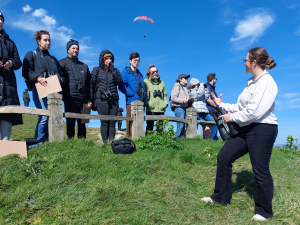 Thea is passionate for all things cetacean “Marine mammals, dolphins in particular, are not just amazing to look at, they’re incredibly charismatic. They have spectacular behaviour and they’re vital parts of our ecosystem. The Sussex Coastline and the Eastern English Channel in general is very underappreciated, particularly when it comes to biodiversity and the public perception of what’s out there. We want to reconnect people back to the sea and encourage them to protect their local wildlife from the many pressures they face in our waters.”
Key to that protection is Citizen Science. It’s one of the leading tools which many conservation organisations are now using to gain information where they don’t have the resources to act “It’s simple,” explains Thea “if we have no data, it’s impossible to know what we have to conserve.” Sussex Dolphin Project is asking for more volunteers to join its Landwatch programme. A community of Citizen Scientists who visit the coast to record the presence, or absence, of marine species in Sussex. And so I have the privilege of joining a training day for the newest group of volunteers one sunny Easter afternoon on Beachy Head. Thea is our trainer.
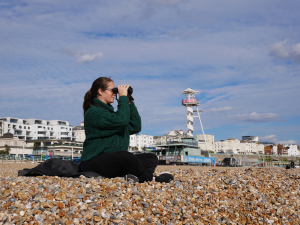
Anyone can become a citizen scientist. You don’t need a scientific background. My fellow trainees have come from all walks of life and from all over Sussex and Kent. The main qualities needed are patience and enthusiasm, as sometimes, like today, these chancy animals don’t always put in an appearance. Of course there are favourite spotting locations like Beachy Head or Rottingdean. But just an hour a week on any bit of beach is useful as every record, positive or negative will constitute a valuable data point for the scientists. Plus, there’s no surveying in rough weather, because you won’t see the dolphins anyway. She hands us binoculars-valuable, but the unaided eye has a better field of vision-and data forms, designed to record every useful detail, both of the cetaceans themselves and things around them like sea state, weather and of course the movements of boats which can sometimes be a problem to shy species like porpoises.
Happily, the programme is working. “From the data we’ve collected in just 5 years, we’ve provided evidence for the implementation for the IMMA.” (Important Marine Mammal Area),-a new conservation zone which covers most of the Channel. Every observation the volunteers make gets collated into databases which help researchers all around the world. Valuable work because cetaceans are important indicator species. “They’re very good at telling us about the health of our ecosystems,” says Thea, “If we don’t see any megafauna we don’t have any fish, basically.”
Sussex Dolphin Project is part of the South Coast Marine Mammal Consortium, an umbrella organisation which co-ordinates research and conservation of marine mammals along the south coast of England There is a network of relationships with many bodies, both national and international; managing it keeps Thea busy. Their collective efforts are showing some results: “The Near shore trawling by-law and the Sussex Bay kelp project has been a massive success,” she says, “not only from a biodiversity point of view, but also from a public engagement point of view, and our Citizen Science is going really well.” She points to the success of their education and awareness programmes in schools “I think young people are far more aware than the older generation. They’ve been brought up to be more conscious of the environment.” And the negatives? “The large-scale fishing that still happens in the eastern English Channel and the lack of enforcement and monitoring restrictions on those vessels.” Pollution is a headache too, not just the recent bad container incidents, but in general, such as persistent organic pollutants or heavy metal pollution which impact our marine mammals. So much remains to be done.
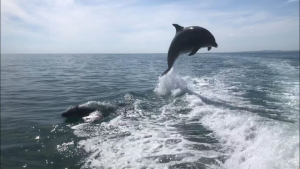
Bottlenose Dolphin spotted one mile out of Brighton
But seeing the animals make it all the effort worthwhile “Bottlenose dolphins in particular are show-offs. We’ve had some great interactions where they’ve been fishing and they’ve brought fish to the surface and waved it in front of the boat. Or where the boat has been playing music and the dolphins seem to move to the beat.”
Sadly, we don’t see any dolphins today, or porpoises, or even the seals which sometimes bask on the rocks at the foot of the cliffs. They are still too few, and face many problems. But thanks to the patient work of the Sussex Dolphin Project, we now have some practical ways to help them. And that’s what counts.
For more information: Sussex Dolphin Project
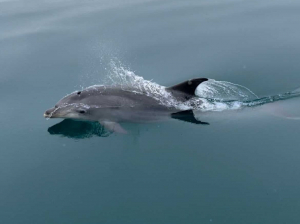
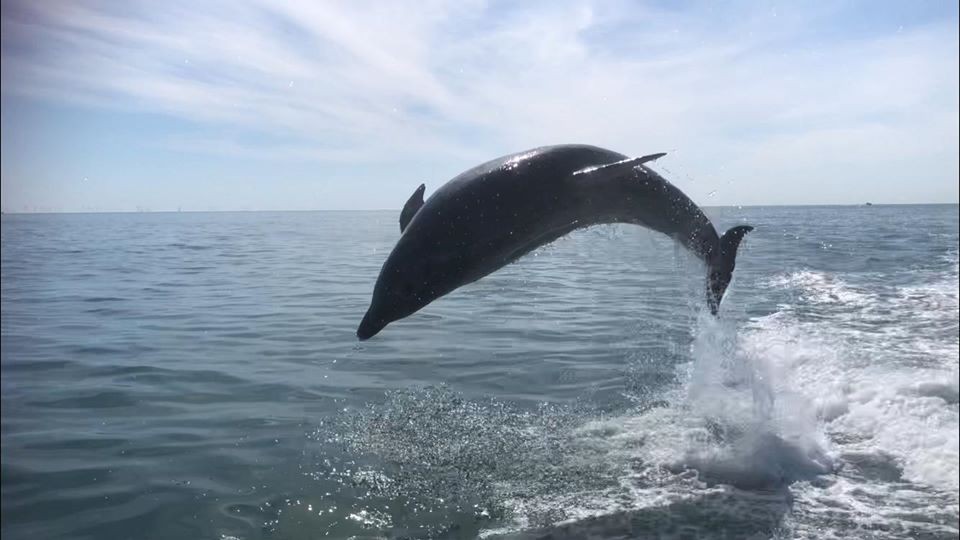
Bottlenose dolphin swimming at Rampion Windfarm
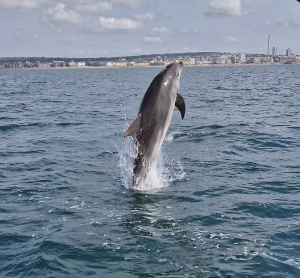
Dolphin spotted 2 miles south of Hove