
Sussex Green Living
  • About Us
    • Our Ambition
    • Meet the Team
    • Volunteer with us
    • Awards & Recognition
  • News
  • Solutions
    • Repair Cafes
    • Sussex Green Hub
      • Horsham Repair Café
      • Horsham Repair Café House Rules
    • Refill
      • Storrington Refill and Return
      • Refill Shops
      • Give Dry A Try
    • Recycling
    • Renature
    • Library of Things
    • Books & Videos
  • Events
    • Events Calendar
    • Book the Eco Float
  • Businesses
  • Education
    • Our Education Programmes
    • Resources
      • Films & Books
      • Video Resources
  • Green Ideas
    • Energy Saving
    • Water Saving
    • Food Waste
    • Composting
    • Shop Local
    • Love your clothes
    • Thriving Communities
    • Use Your Voice
  • Contact
  • Donate
  • Click to open the search input field Click to open the search input field Search
  • Menu Menu
  • Link to Facebook
  • Link to Instagram
  • Link to Youtube
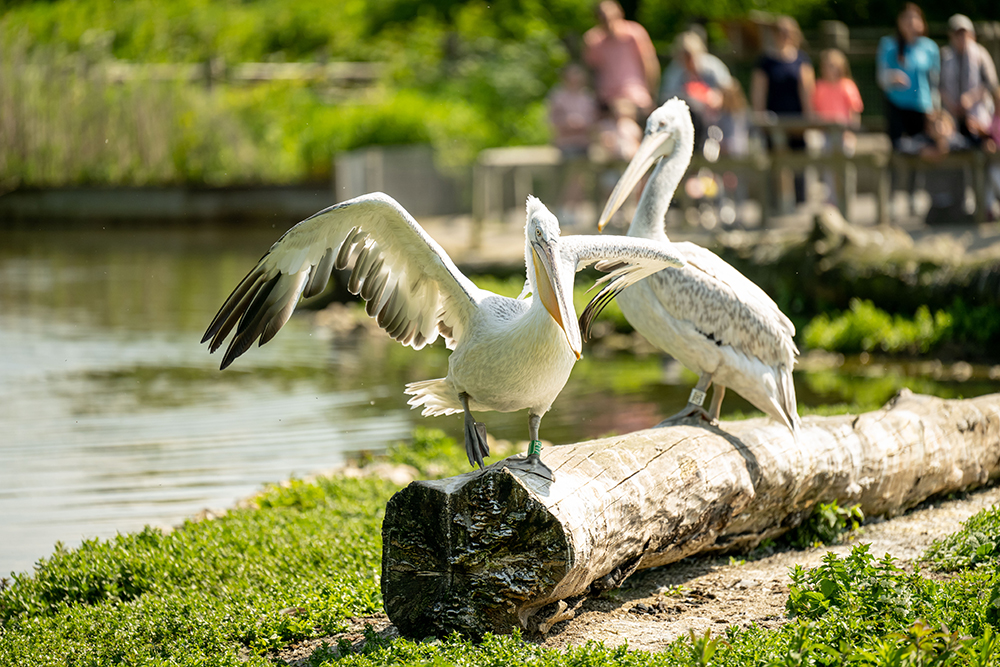
two pelicans walking on logWWT Arundel Wetlands Centre

Arundel wetlands Centre – Communicating the Message of Nature

February 4, 2026/in Biodiversity & Nature, Children & nature, Education, Take Action/by Marianne Lindfield

Written by Keir Hartley

“The most effective way to save the threatened and decimated natural world is to cause people to fall in love with it again-with its beauty and its reality” This was the vision of Sir Peter Scott, the tireless broadcaster and naturalist who established the Wildfowl and Wetlands Trust. We visited the WWT’s Arundel Wetland Centre in the year of its 50th anniversary, the WWT’s 80th, just before World Wetlands Day on 2 February, to investigate his legacy.  

We started our morning by meeting Marketing and Communications Manager Pat Warren and Reserve manager Suzi Lanaway in the impressive Visitors Centre. It’s a bright open space with huge picture windows looking out over a large lake bustling with all kinds of water birds such as geese, ducks and teals. As we sipped our coffee and talked, we couldn’t fail to notice the occasional blue flash of a kingfisher darting to the water a few feet from where we sat. 

There is no doubt that Scott’s vision is alive here today. “Wetlands have superpowers” explained Pat, “they store carbon, help prevent flooding, and are a habitat for an enormous range of species.” Many of these are rare or migrating birds whose chances of life would be slim indeed without the Arundel Wetlands Centre. Among their proud success stories are marsh harriers snipe, teal and sand martins, of which more later. 

Preserving species is vital: but they achieve more in partnership than alone. “I suppose every bit of land managed with wildlife in mind is important” says Suzi. To this end, the Arundel Centre works in every way it can with local farmers, land managers and residents to ensure that the sanctuary of the trust fits into a wider network of viable habitats, wildlife corridors-and people who understand its vision. Above all, this must include the public. If you want learning to be fun, this is the place to come. Spring and summer tend to be family-leaning, where visitors can enjoy the walks, the hides and the many activities such as pond dipping and safari boat rides as well as slightly messier adventures such this half term’s Mudfest. There’s a regular schools visit programme – but to ensure maximum connection, Arundel is part of the WWT’s immersive Generation Wild programme, which facilitates free visits for schools from deprived areas, with family follow ups, Autumn and winter see more adults. Groups like birdwatchers and  photographers, some with incredibly impressive-looking cameras, have formed their own social and online networks around the centre. By engaging with them, Pat is extending her messaging into the new world of social media, thereby winning new allies. 

Briefings over, Pat led us on our extensive tour. At 65 acres, Arundel is one of the smaller wetland centres but it hosts an impressive array of marshes, reed beds, lakes and islands, many alive with bird life even in grey January. There is a network of sturdy walkways, which allow an efficient and mud-free close approach to nature. All are signposted and equipped with informative storyboards. One of the walkways led us to the sand martin hide. A chunky reddish structure built to resemble a sandy riverbank which the birds tunnel into, the natural nesting spot for sand martin colonies in the UK. And what a success it has been! Starting with three nests in 2019, it has grown with almost mathematical progression: seven in 2020, 15 in 2021, 24 in 2022, 83 in 2024 and 150 last year. No wonder Pat and Suzi were so proud of it. 

As part of WWT, the Arundel Centre is a charity. So, it depends on the work of a network of volunteers to aid the regular staff. There is the annual labour of clearing scrub and reeds, or the lakes would eventually revert to woodland. Sites of Special Scientific interest such as the reed warblers’ habitats must be assiduously maintained and the warming climate may threaten many of the amphibians and aquatic invertebrates with extinction – and end the birds’ supply of food. 

And we could not close our visit without a mention of the spectacularly impressive Dalmatian Pelicans. A group is maintained as part of the centre’s links to international conservation efforts, even though they became extinct in England many centuries ago. Their enormous bills and colossal wingspans gave them the faint air of those pterodactyls you used to see in old dinosaur books. Who knows, maybe one day they will take their place alongside beavers and kites that are currently making their way back to their rightful homes. 

Conservation must communicate to succeed. If the ghost of Sir Peter Scott returned today, he would conclude that the Arundel Wetland Centre was a true custodian of his belief. 

www.wwt.org.uk/wetland-centres/arundel 
Two Sand Martins perched on a box

Share this entry
  • Share on Facebook
  • Share on X
  • Share on WhatsApp
  • Share on Pinterest
  • Share on LinkedIn
  • Share on Tumblr
  • Share on Reddit
  • Share by Mail
https://www.sussexgreenliving.org.uk/wp-content/uploads/2026/02/Pelican-talk-at-Pelican-Cove.jpg 667 1000 Marianne Lindfield https://www.sussexgreenliving.org.uk/wp-content/uploads/2022/08/SGL-logo-158-x-78-RGB.png Marianne Lindfield2026-02-04 17:37:512026-02-04 17:37:51Arundel wetlands Centre – Communicating the Message of Nature

Recent Blog Posts

  • Communities and Churches Unite Around Climate Emergency Film May 14, 2026
  • A Pop-up with Purpose: Community Collaboration Brings Wellbeing & Sustainability To Horsham May 5, 2026
  • How growing your own food benefits health, wallet and environment April 28, 2026
  • Donations set to double in national campaign April 16, 2026
  • A Greener Spring Clean: Why Charity Recycling Beats Mining Finite Resources April 13, 2026
Search Search

Blog Post Archive

Tag Cloud

beach clean bees biodiversity climate change Community Event energy saving environment farmer farm shop flowers food waste gardening green business network green thing grow-your-own homegrowing Horsham Eco Churches money saving nature news packaging PES pollinators press_release produce Recycling refill refuse renature repair cafe reuse rubbish seed swap spring supermarkets sussex green hub sussex green living sussexgreenliving Sustainable Living transition horsham United Reformed Church vegetables Wildflowers wildlife wildlife conservation
E-Mail sign-up

Follow Us

Follow us on FacebookFollow us on InstagramConnect with us on LinkedIn

Registered with Fundraising Regulator

Contact Us

Message Us

Search

Search Search

Your personal information

Our Privacy Policy

Cookies: By continuing to browse the site, you are agreeing to our use of cookies.
Learn more

eNewsletter Sign-up

Get every post & our e-news to your inbox.

Subscribe Here
© Copyright - Sussex Green Living 2026 | Website: Starling Design
  • Link to Facebook
  • Link to Instagram
  • Link to Youtube
Link to: Birds in February: Challenges, Hope, and the Actions Homeowners Can Take Link to: Birds in February: Challenges, Hope, and the Actions Homeowners Can Take Birds in February: Challenges, Hope, and the Actions Homeowners Can TakeRichard Sharman Link to: How Sussex Golf Courses are Embracing Eco-Friendly Practices Link to: How Sussex Golf Courses are Embracing Eco-Friendly Practices Gold course in SussexHow Sussex Golf Courses are Embracing Eco-Friendly Practices
Scroll to top Scroll to top Scroll to top

This site uses cookies. By continuing to browse the site, you are agreeing to our use of cookies.

OKLearn more

Cookie and Privacy Settings


How we use cookies

We may request cookies to be set on your device. We use cookies to let us know when you visit our websites, how you interact with us, to enrich your user experience, and to customize your relationship with our website.

Click on the different category headings to find out more. You can also change some of your preferences. Note that blocking some types of cookies may impact your experience on our websites and the services we are able to offer.

Essential Website Cookies

These cookies are strictly necessary to provide you with services available through our website and to use some of its features.

Because these cookies are strictly necessary to deliver the website, refusing them will have impact how our site functions. You always can block or delete cookies by changing your browser settings and force blocking all cookies on this website. But this will always prompt you to accept/refuse cookies when revisiting our site.

We fully respect if you want to refuse cookies but to avoid asking you again and again kindly allow us to store a cookie for that. You are free to opt out any time or opt in for other cookies to get a better experience. If you refuse cookies we will remove all set cookies in our domain.

We provide you with a list of stored cookies on your computer in our domain so you can check what we stored. Due to security reasons we are not able to show or modify cookies from other domains. You can check these in your browser security settings.

Other external services

We also use different external services like Google Webfonts, Google Maps, and external Video providers. Since these providers may collect personal data like your IP address we allow you to block them here. Please be aware that this might heavily reduce the functionality and appearance of our site. Changes will take effect once you reload the page.

Google Webfont Settings:

Google Map Settings:

Google reCaptcha Settings:

Vimeo and Youtube video embeds:

Privacy Policy

You can read about our cookies and privacy settings in detail on our Privacy Policy Page.

Privacy Policy
Accept settingsHide notification only
Sussex Green Living
Follow Sussex Green Living

Get every post & our e-news delivered straight to your inbox:

Invalid email address
You can unsubscribe at any time.
Thanks for subscribing!