The new Leader of Horsham District Council, Cllr Jonathan Chowen, has made a series of new cabinet appointments, including Cllr James Wright as Cabinet Member for Environment and Rural affairs, and Cllr Toni Bradnum as Cabinet Member for Recycling and Waste and we were delighted that they both saw our Sussex Green Hub in action […]
00Carrie Corthttps://www.sussexgreenliving.org.uk/wp-content/uploads/2026/07/SGL-logo-masthead.pngCarrie Cort2022-02-04 22:12:032022-02-04 22:12:03Horsham District Council new cabinet
00Marianne Lindfieldhttps://www.sussexgreenliving.org.uk/wp-content/uploads/2026/07/SGL-logo-masthead.pngMarianne Lindfield2022-01-06 11:00:042022-01-06 11:00:04Sussex Green Living 2021 Roundup By Morag Warrack
Beneath our feet is a world that many do not even consider to be part of us, yet within two handfuls of healthy soil are more living organisms than people on our planet. It is within the first four inches that most food chains start; at the microscopic levels, bacteria eating protozoa and nematodes. These […]
00Marianne Lindfieldhttps://www.sussexgreenliving.org.uk/wp-content/uploads/2026/07/SGL-logo-masthead.pngMarianne Lindfield2021-12-11 09:00:592021-12-11 09:00:59The Mystery by Clive Cobie (first published in West Sussex County Times)
Sussex Green Living’s Youth Eco Forum is a young persons’ environmental group where we speak about current news and creatively demonstrate climate activism in many forms. The YEF was founded in June 2020 in the hope of connecting like-minded teenagers to make a difference for our planet during a period of disconnection… so we started […]
00Marianne Lindfieldhttps://www.sussexgreenliving.org.uk/wp-content/uploads/2026/07/SGL-logo-masthead.pngMarianne Lindfield2021-12-07 17:45:452021-12-07 17:45:45Sussex teenagers unite to take action on climate by Max Moorcroft (first published in West Sussex County Times)
Eco milk float rising to the carbon reduction challenge
Pop-up and rock-up
An eco 1974 milk float, pop-up shop and pop-up climate emergency centre – what do they all have in common? They are all initiatives offered by multi-award-winning charity Sussex Green Living, to help people reduce their carbon footprint.
It might be hot air in Glasgow but not at the grassroots where this charity is concerned. On the first day of COP26 the charity became part of a new pop-up shop on the high street. They popped up their first once a month climate emergency centre, the Sussex Green Hub, on 25th September and earlier in the year saw the first appearance of their unique and quirky mobile eco display, a 1974 retrofitted milk float, called the Inspiration Eco Station, and the launch of their Bright New Future Roadshow. Read more
00Carrie Corthttps://www.sussexgreenliving.org.uk/wp-content/uploads/2026/07/SGL-logo-masthead.pngCarrie Cort2021-11-11 19:39:492021-11-11 19:39:49Eco milk float rising to CO2 challenge
Imagine a beautiful Persian carpet. Then cut it into a thousand squares. What do you get? Not a thousand smaller Persian carpets but a thousand scraps of cloth unravelling at the edges. That’s what’s happening to nature in the modern landscape, the scraps becoming ever smaller as the threads begin to trip us up. It is causing the Sixth Mass Extinction – a catastrophic loss of biodiversity affecting the whole planet.
We can see the unravellings all around us if we know how to look. A patch of ancient woodland surrounded by a monoculture of arable is vulnerable to ‘edge effect’ – the drift of chemical sprays, exposure to wind, extreme heat and frost – eating away at habitat on its periphery. That single ancient oak in the middle of a field of wheat has its roots assaulted by ploughing every year. The fine fungal filaments – or mycorrhizae – leading off its roots in search of nutrients are drenched several times a year in agricultural chemicals. The tree can no longer communicate underground with other trees. It is like a lone elephant in a zoo, deprived of the society of its herd, doomed to die alone. Read more
00Marianne Lindfieldhttps://www.sussexgreenliving.org.uk/wp-content/uploads/2026/07/SGL-logo-masthead.pngMarianne Lindfield2021-10-23 09:36:172021-10-23 09:36:17Nature Networks by Isabella Tree (first published in West Sussex County Times)
The new kelp forest off the Sussex coast is becoming real. That’s the message from Councillors and wildlife and fisheries experts. And it puts Sussex in the forefront of efforts to combat global warming, habitat destruction and the return to a cleaner, more sustainable world.
The marine forest which stretched between Chichester and Rye was destroyed by storms and trawling in the 1980s but is now being restored.
“Given the extent of kelp loss it may take many years for kelp to recover to the density and distribution once known”, says Tim Dapling, Chief Officer for Sussex Inshore Fisheries and Conservation Authority. “Early information appears to show changes in the environment already taking place since trawling management was introduced in March 2021. It will be very interesting to see changes in 4-5 years time.” Read more
00Marianne Lindfieldhttps://www.sussexgreenliving.org.uk/wp-content/uploads/2026/07/SGL-logo-masthead.pngMarianne Lindfield2021-10-21 10:21:582021-10-21 10:21:58Sussex Kelp Forest Leads the Way by Keir Hartley (first published in West Sussex County Times)
Seals on our Sussex coast show that conservationists are getting something right. It’s not just Gavin the well-loved harbour seal who sports with paddle boarders in Littlehampton; we can see these marvellous creatures now in Chichester harbour, Eastbourne and in the Adur, where two seals named Bramble and Rivier (who swam in from Belgium) have generated their own following.
According to Zoologist Stephen Savage of the Sea Watch Foundation, it’s a wonderful sign that our waters are clean enough to support food for these large animals. “They like mullet, flatfish and crabs mainly” he explains, “but they hunt anywhere in tidal or brackish water, even as far up as The Black Rabbit at Arundel.”
Stephen, who is County Recorder for Sea Mammals, has studied seals since 1997. The public have been stalwart supporters. Initially he collated sighting reports, but eight years ago increasing seal numbers allowed him to build a picture of populations in Sussex. “We hope to learn even more through citizen science” says Stephen. “The interaction of seals and people will significantly add to this story.” Read more
00Marianne Lindfieldhttps://www.sussexgreenliving.org.uk/wp-content/uploads/2026/07/SGL-logo-masthead.pngMarianne Lindfield2021-09-08 11:45:412021-09-08 11:45:41Seal of success! by Keir Hartley (first published in West Sussex County Times)
How Green is Copper? With a rush for electric cars and renewable power some of the most biodiverse areas on Earth are under threat. Hidden beneath primary forest teeming with life metals lay buried.
Whilst Ecuador was the first country in the world to put the #rightsofnature in its #constitution, sadly this has not stopped foreign interest from wanting to mine one of the most biodiverse places on the planet.
The Los Cedros Reserve is almost 12,000 acres of untouched cloud forest. Imagine over 400 different kinds of orchids, over 350 species of birds, 800 different kinds of moths and uncountable species of fungi. 5 critically endangered and 31 endangered species make this their home.
This little known reserve is more biodiverse than the Amazon.
Still the Canadian mining company Cornerstone Capital Resources buy off the local people with trinkets , beads and the promise of work. They do not talk about the potential risk of contaminating their water source or of what will happen when they leave.
The world is watching this vital case. If Nature wins it means that not only Los Cedros can breathe a sigh of relief but over 6 million acres of protected land which is under the threat of mining. This will in turn set an international precedent. Read more
00Marianne Lindfieldhttps://www.sussexgreenliving.org.uk/wp-content/uploads/2026/07/SGL-logo-masthead.pngMarianne Lindfield2021-09-05 18:43:102021-09-05 18:43:10How Green is Copper? by Nicola Peel
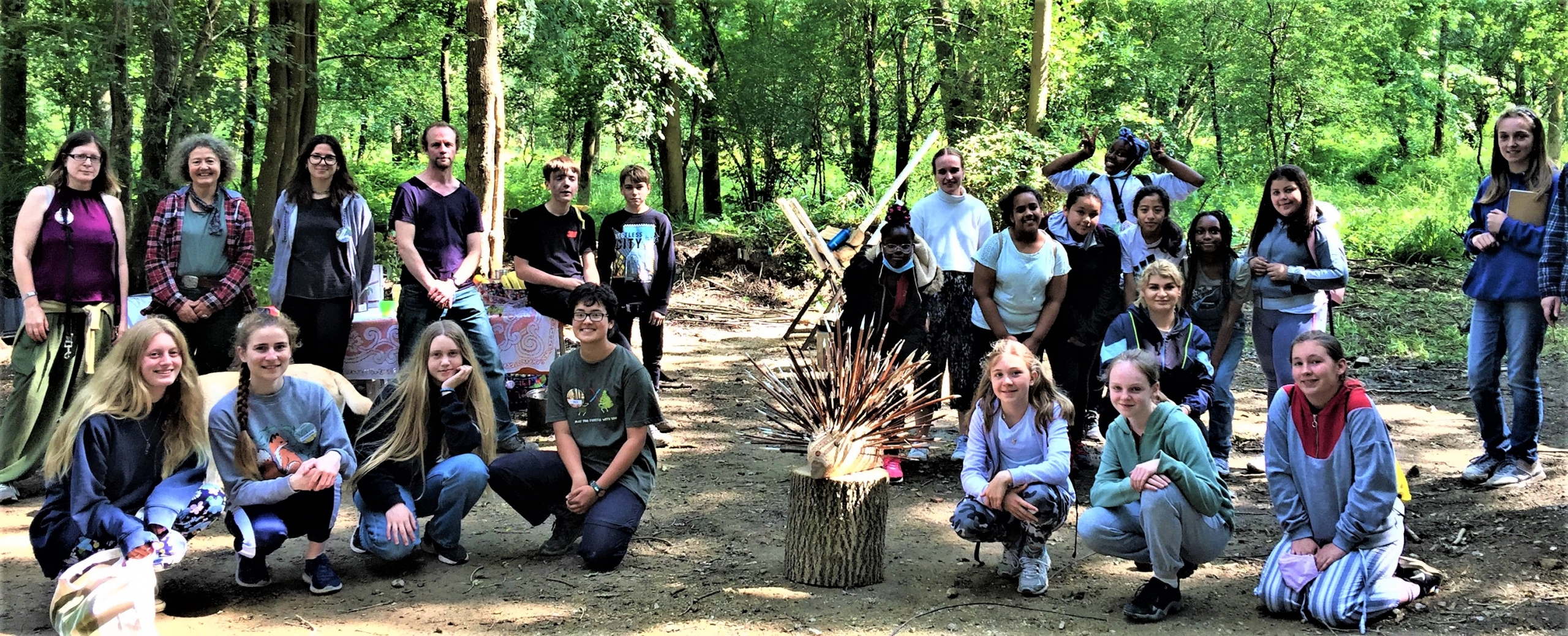
On Wednesday 14th July, Sussex Green Living’s Youth Eco Forum led a day of outdoor activities in an area of ancient woodland near Billingshurst. The event, named Beyond Be-Leaf, hoped to give young people who would not usually have the opportunity to get out in the countryside a chance to get hands-on and creative, learning about the natural world. Youth Eco Forum Member, Flora Burleigh reflected that the best thing about the day was, “simply observing the students as they were immersed in nature, watching them be inspired and actually having the opportunity to pay a closer attention to the woodland environment.”
Year 7 and 8 pupils from Tanbridge House School, Christ’s Hospital School and City of London Academy Southwark spent the day learning about the local wildlife, woodland management, and positive climate solutions. They had the opportunity to explore their connection to nature through creative writing and dance workshops as well as learning woodcraft skills and going on a nature walk. Some of the young attendees had never been to the countryside before and this made the event a particularly exciting and revelatory experience. Read more
00Marianne Lindfieldhttps://www.sussexgreenliving.org.uk/wp-content/uploads/2026/07/SGL-logo-masthead.pngMarianne Lindfield2021-08-26 11:38:552021-08-26 11:38:55Beyond Be-Leaf by Catherine Sleeman of Horsham Youth Eco Forum (first published in West Sussex County Times)
We may request cookies to be set on your device. We use cookies to let us know when you visit our websites, how you interact with us, to enrich your user experience, and to customize your relationship with our website.
Click on the different category headings to find out more. You can also change some of your preferences. Note that blocking some types of cookies may impact your experience on our websites and the services we are able to offer.
Essential Website Cookies
These cookies are strictly necessary to provide you with services available through our website and to use some of its features.
Because these cookies are strictly necessary to deliver the website, refusing them will have impact how our site functions. You always can block or delete cookies by changing your browser settings and force blocking all cookies on this website. But this will always prompt you to accept/refuse cookies when revisiting our site.
We fully respect if you want to refuse cookies but to avoid asking you again and again kindly allow us to store a cookie for that. You are free to opt out any time or opt in for other cookies to get a better experience. If you refuse cookies we will remove all set cookies in our domain.
We provide you with a list of stored cookies on your computer in our domain so you can check what we stored. Due to security reasons we are not able to show or modify cookies from other domains. You can check these in your browser security settings.
Other external services
We also use different external services like Google Webfonts, Google Maps, and external Video providers. Since these providers may collect personal data like your IP address we allow you to block them here. Please be aware that this might heavily reduce the functionality and appearance of our site. Changes will take effect once you reload the page.
Google Webfont Settings:
Google Map Settings:
Google reCaptcha Settings:
Vimeo and Youtube video embeds:
Privacy Policy
You can read about our cookies and privacy settings in detail on our Privacy Policy Page.

 Press Release



 Community Wellbeing Garden
 Sussex Green Living
 Sussex Green Living
 Biffa
Biffa